Investor Reporting in EB-5: Why Ongoing Communication Matters After Subscription

Updated: Aug 4

Once an investor subscribes to an EB-5 offering, the need for clear communication does not end.
EB-5 investors are generally not involved in the project’s day-to-day management. They rely on the regional center and project team to provide timely, understandable information about capital deployment, project progress, job creation, and material developments.
Before investing, families should understand what information they can expect to receive, how updates are typically delivered, and who will be available to answer project-related questions.
What Should EB-5 Investor Reporting Cover?
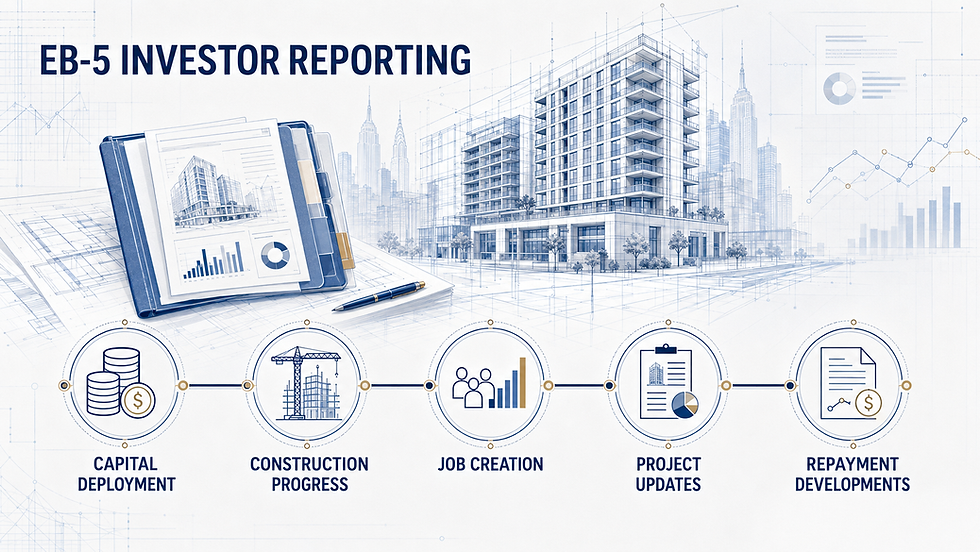
Reporting practices vary by project, but useful investor updates may cover:
Deployment and use of EB-5 capital;
Construction progress and major project milestones;
Job-creation progress or supporting project data;
Material changes affecting the project;
Repayment, refinancing, or exit-related developments, when applicable.
The purpose of reporting is not to suggest that a project will proceed without delays or changes. It is to help investors understand what is happening after their capital has been committed.
In addition to general project updates, organized records may later support project-related documentation needed by investors and their immigration counsel during the I-526E and I-829 stages.
Why Ongoing Communication Matters
1. It gives investors visibility
Because investors are not managing the project directly, regular updates help them compare actual progress with the project’s development and financing plans.
Clear reporting also makes it easier to understand whether construction milestones, capital deployment, and other material developments remain generally consistent with the original project strategy.
2. It supports documentation continuity
EB-5 is both an investment process and an immigration process. Project records may remain relevant long after the initial investment is made.
USCIS explains that regional center audits may verify information contained in regional center applications, annual certifications, and associated investor petitions. Maintaining organized, consistent records therefore supports both program compliance and future investor documentation.
Industry guidance also describes fund administration as including financial reporting, investor communications, and monitoring investment compliance—functions that help create a more transparent record throughout the investment period.
3. It provides context when circumstances change
Even well-structured real estate projects may experience construction delays, financing changes, or shifting market conditions.
When material developments occur, investors should receive a clear explanation of what changed, why it matters, and how the project team is responding. Transparent communication does not eliminate risk, but it helps reduce uncertainty and prevents investors from learning about important developments too late.

What Does Effective Investor Reporting Look Like?
Effective reporting should be clear, consistent, and relevant.
Before subscribing, investors may want to ask whether the regional center provides:
A general reporting schedule or communication cadence;
Plain-English summaries of project developments;
Timely notice of material changes;
Organized access to important project records;
A designated investor-relations contact.
Updates may be delivered through written reports, emails, investor portals, webinars, or a combination of these formats.
The format matters less than the consistency and quality of the information provided.
Questions to Ask Before Investing
Investors may want to ask:
How often are project updates generally provided?
What information is typically included?
How are material delays or changes communicated?
Who is responsible for investor relations?
Will the regional center provide project-related information needed by investors and their immigration counsel?
These questions are best addressed before the investment is made.
The ARCFE Approach
At ARCFE, the investor relationship continues after subscription.
ARCFE provides project-related updates and works to keep investors and their counsel informed throughout the I-526E, conditional permanent residence, and I-829 stages.
Founded by iCross Capital, a New York City real estate financing institution with nearly 20 years of lending experience, ARCFE brings an institutional real estate credit perspective to project evaluation and monitoring. ARCFE has also raised and managed EB-5 capital for 20 projects, providing the organization with more than a decade of experience supporting EB-5 investors.
This background helps ARCFE focus its investor communications on the information that matters most: capital deployment, construction progress, material project developments, job-creation support, and repayment-related updates when appropriate.
For ARCFE, ongoing communication is not an administrative formality. It is part of maintaining transparency and supporting investor confidence throughout a multiyear EB-5 process.

Final Thoughts
Investor reporting may not be the first issue families consider when comparing EB-5 projects, but it often becomes one of the most important after investing.
A regional center should be able to explain how it monitors the project, what information investors will receive, and how material developments will be communicated.
Before subscribing, investors should evaluate not only the project being offered, but also the reporting practices and long-term support behind it.
To learn more, read How to Choose an EB-5 Regional Center, review Track Record, Transparency, and Trust: How to Evaluate an EB-5 Regional Center, or explore the ARCFE EB-5 Process.
Speak with our EB-5 specialist and learn how the program can help you achieve permanent residency. Complete the form and our team member will give you a call back.
Related ARCFE Resources