
EB-5 Path of Funds: How to Document Cross-Border Transfers


For international EB-5 investors, investment capital may move between banks, accounts, and countries before reaching the U.S. investment.
USCIS reviews the path of funds to understand how the money moved from its documented lawful source into the EB-5 investment.
For investors using international bank transfers or currency exchange services, maintaining a clear transaction history helps establish that connection.
1. What Does the EB-5 Path of Funds Need to Show?
The source of funds establishes how investment capital was lawfully obtained. The path of funds documents how that capital moved into the investment.
For an international transfer, the documentation may cover several stages:
Transfer Stage | Typical Supporting Records |
Original Account | Bank statements showing the funds held by the investor |
Account-to-Account Transfers | Transfer confirmations and corresponding bank transactions |
Currency Conversion | Foreign exchange confirmations, transaction records, and applicable bank statements |
EB-5 Investment Transfer | Wire confirmation and receipt of funds by the New Commercial Enterprise (NCE) |
Not every investment involves each stage. The documents should reflect the actual transactions.
Under the USCIS Form I-526E instructions, investors must provide supporting evidence of the lawful source and transfer of their investment capital.
For a broader introduction, see the iCross × ARCFE Source of Funds Guide.
Planning an EB-5 Investment?
Discuss ARCFE’s projects, funding steps and subscription process with our team.
2. How Can Investors Document Transfers Across Countries?
International transfers often involve several financial institutions.
An investor may transfer funds from a domestic account to an overseas account, convert the currency, and then send the funds to the EB-5 investment account.
Bank records can help connect these transactions by showing the relevant account holders, dates, amounts, and transfer details.
Where currency conversion is involved, exchange confirmations can explain the difference between the original currency amount and the U.S. dollar amount received.
A clear transaction history allows the transfer sequence to be followed from the original account to the final investment.

An illustrative funding path; the records should match the actual transfers and any intermediaries. Illustration: iCross × ARCFE.
The USCIS Policy Manual provides further guidance on documenting lawful investment capital.
3. What if a Third Party Helps Transfer the Funds?
Some international transactions may involve a currency exchange provider or another party acting on the investor's behalf.
The EB-5 Reform and Integrity Act of 2022 requires investors to identify third parties who transfer investment capital into the United States on their behalf.
Relevant documentation may therefore include the intermediary's identity, applicable registration information, and records of the transactions handled.
The precise information depends on the transfer arrangement. Investors can review the statutory EB-5 source-of-funds requirements and discuss their intended transfer method with immigration counsel.
Using established, lawful financial channels and keeping the corresponding transaction records can make the funding history easier to document.
4. How Should Investors Prepare Their Transfer Records?
A practical approach is to organize the records chronologically, beginning with the original source account and ending with the investment confirmation.
The records should allow the investment amount to be traced through the relevant transfers, with supporting documentation for any currency conversions or intermediary transactions.
Investors using family gifts or loan proceeds should also coordinate those source-of-funds records with the transfer history.
Qualified immigration counsel can review the intended funding path and supporting documents as part of the petition preparation process.
For an overview of the broader investment and filing process, visit the iCross × ARCFE EB-5 Process Guide.
The iCross × ARCFE Perspective
At iCross × ARCFE, we work with investors from different international markets, where investment funding arrangements may vary according to banking practices and individual circumstances.
Our team focuses on helping investors understand the EB-5 investment structure, subscription procedures, and project-related documentation. Investor-specific transfer arrangements and immigration evidence should be coordinated with qualified legal and financial professionals.
ARCFE's foundation in New York City real estate lending also informs our approach to financing structure and capital management at the project level.
For international investors, a clear funding record helps connect personal financial preparation with the EB-5 investment process.
Disclaimer: This article is provided for general informational purposes only and does not constitute immigration, legal, tax, banking, or investment advice. International transfers must comply with applicable requirements, and documentation needs vary by transaction and jurisdiction. Investors should consult qualified professionals regarding their circumstances.
Recent ARCFE EB-5 Principal Repayment Highlights
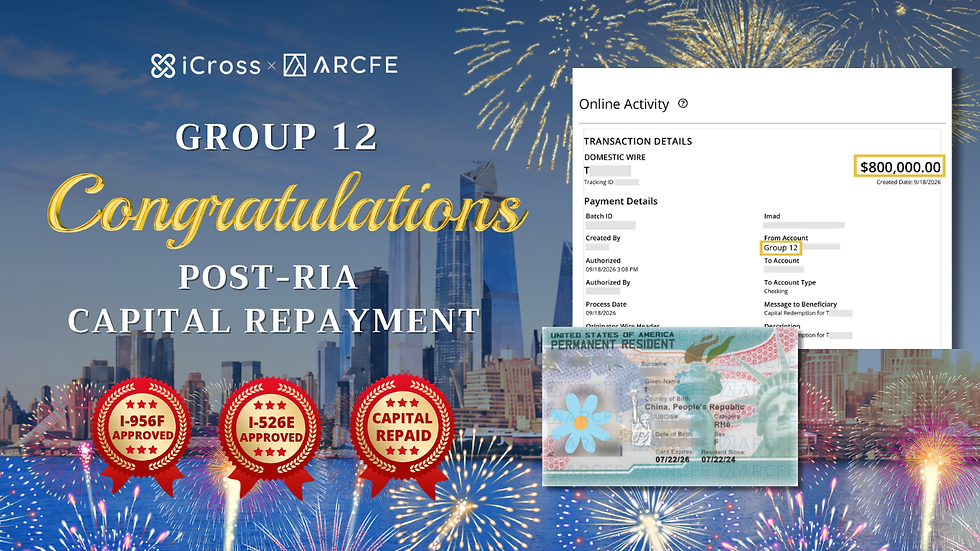
Explore ARCFE’s latest EB-5 principal repayment milestones across pre-RIA and post-RIA projects. Click any image below to read the full project update.

Explore Current New York Real Estate-Backed EB-5 Opportunities


Considering EB-5 for Your Family?
Speak with an iCross × ARCFE EB-5 specialist to discuss your immigration goals, timeline, and available investment opportunities.
Related ARCFE Resources
Review lawful-source documentation and the records that trace capital into an EB-5 investment.
Learn how families document genuine gifts, donor funding sources and transfers.


