
Holiday Travel 2026: F‑1, OPT and H‑1B Checklist


Before booking holiday travel abroad, F-1 students, graduates on OPT and H-1B professionals should check the documents they will use to return to the United States.
In its November 3 travel alert, immigration law firm Fragomen urged foreign nationals to review their immigration documents and visa arrangements before finalizing holiday plans.

Holiday Travel Documents to Check Before Departure
Start with your passport’s validity and the visa you plan to use for reentry. Valid U.S. status does not necessarily mean that the visa in your passport is valid for your return. Travelers returning in a nonimmigrant classification generally need a valid visa unless an exemption applies.
Status or Stage | Key Documents and Checks |
|---|---|
F-1 students | An active SEVIS record and Form I-20 with a valid travel endorsement from the school’s designated school official (DSO). |
F-1 graduates on post-completion OPT | Form I-20, a valid EAD and evidence of employment or a job offer, in addition to the passport and visa. Check the travel-endorsement date. |
H-1B professionals | The appropriate visa, Form I-797 approval notice and current employment documentation consistent with the employer and approved status. |
For post-completion OPT, the I-20 travel endorsement generally must be no more than six months old on the return date. Review SEVP’s travel guidance and confirm your documents and SEVIS record with your DSO before departure.
If You Need a New Visa, Plan the Appointment First
If your visa has expired and you need a new one abroad, check the relevant consulate’s appointment availability before committing to flights.
Under State Department guidance, nonimmigrant visa applicants should generally schedule interviews in their country of nationality or residence. Check the consulate’s instructions and allow time for visa processing and passport return, as well as the interview itself.
Travel With a Pending I-485: Check Advance Parole
Most applicants with a pending Form I-485, including eligible EB-5 concurrent-filing applicants, need approved advance parole before leaving the United States. The document should also be valid for the planned return.
As explained in USCIS travel-document guidance, leaving without required advance parole can cause the I-485 to be treated as abandoned. Certain travelers maintaining qualifying H or L status may use an exception. Ask immigration counsel whether it applies and which documents you will use to return.
An I-485 receipt or an EAD by itself is not a travel document.
After reentry, retrieve your latest Form I-94 from CBP and check the class of admission and authorized-stay information. Report any discrepancy promptly to your school, employer or immigration counsel.
A document review before departure can help keep holiday plans on track. iCross × ARCFE will continue to share practical immigration updates for students, professionals and families planning long-term U.S. residence.
This article provides general information and is not legal, immigration, tax or investment advice. Travel requirements and exceptions depend on individual circumstances. Confirm your plans with your school, employer and a qualified U.S. immigration attorney before departure.
Recent ARCFE EB-5 Principal Repayment Highlights
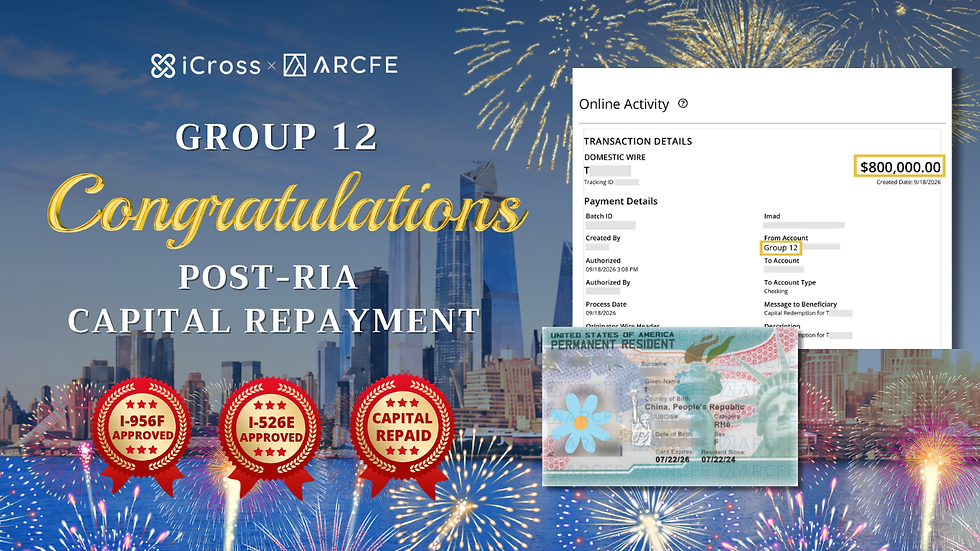
Explore ARCFE’s latest EB-5 principal repayment milestones across pre-RIA and post-RIA projects. Click any image below to read the full project update.

Explore Current New York Real Estate-Backed EB-5 Opportunities


Considering EB-5 for Your Family?
Speak with an iCross × ARCFE EB-5 specialist to discuss your immigration goals, timeline, and available investment opportunities.
Related ARCFE Resources
Explore how eligible students and their families can approach long-term U.S. residence planning.
Review how I-526E, I-485 and separate work and travel applications fit into the process.


