
Lower Manhattan Office Market: Vacancy Falls to 21% as Leasing Slows


The Lower Manhattan office market ended Q3 with overall vacancy at 21%, even as quarterly leasing slowed. The Downtown Alliance’s report released on November 18 also shows Class A asking rents reaching their highest level since 2020. Read together, these measures describe an improving supply-demand balance alongside a quieter quarter for transactions.
Lower Manhattan Office Market: Q3 2026 Figures
Q3 2026 Indicator | Lower Manhattan |
Office leasing activity | 615,000 SF; down 46% from Q2 |
Overall office vacancy | 21% at quarter-end |
Class A asking rent | $65.96 per SF per year |
Year-to-date positive absorption | 2.68 million SF |
The full quarterly report records 576,000 SF of positive absorption during Q3. Its largest lease, Seward & Kissel’s 171,112 SF at 1 Battery Park Plaza, retained an existing presence. Morgan & Morgan’s 70,602 SF at 199 Water Street shifted the firm from a sublease to a direct lease and expanded its footprint. These transactions have different implications for additional space demand.
Considering a New York real estate-backed EB-5 opportunity? Connect with the iCross × ARCFE team to discuss current projects and the markets they serve.
iCross × ARCFE Market Analysis: Reading the Signals Together
Separate transaction activity from the quarter-end position. Leasing volume measures deals signed during a period; vacancy measures the share of space vacant at a point in time. A slower signing quarter can coexist with lower vacancy. For a specific building, distinguish tenant retention, expansion and new arrivals to understand how its demand is changing.
Translate asking rent into a comparable occupancy cost. An office search should compare the cost across the same lease term, including free rent, landlord fit-out contributions and the tenant’s remaining work. Then consider commuting access and the space actually needed. This helps a business judge whether a lower quoted rate also delivers better value for its operating requirements.
Read the office story alongside housing supply. The report records 509 residential units completed in Q3 and says office conversions account for 52% of units planned or under construction. This makes the residential pipeline relevant to the same neighborhood analysis. The report does not isolate how much of the office vacancy decline came from conversions; attributing the entire change to new tenant demand would go beyond its findings.
EB-5 Investor Insight & iCross × ARCFE View
For an apartment search or rental investment, compare homes of the same layout by effective rent and delivery date. As a simple illustration, a $4,000 monthly rent with one free month on a 12-month lease averages about $3,667 per month before other charges. If several nearby buildings open together, those concessions can change the competitive picture even when advertised rents look stable.
For a rental-housing EB-5 project, iCross × ARCFE would connect that comparison to the project’s own schedule: which comparable units will be available during lease-up, what incentives they offer and how occupancy is expected to build month by month. Using effective rents and phased occupancy in an income assessment turns a broad office-market improvement into a more useful, project-specific demand question.
News Sources
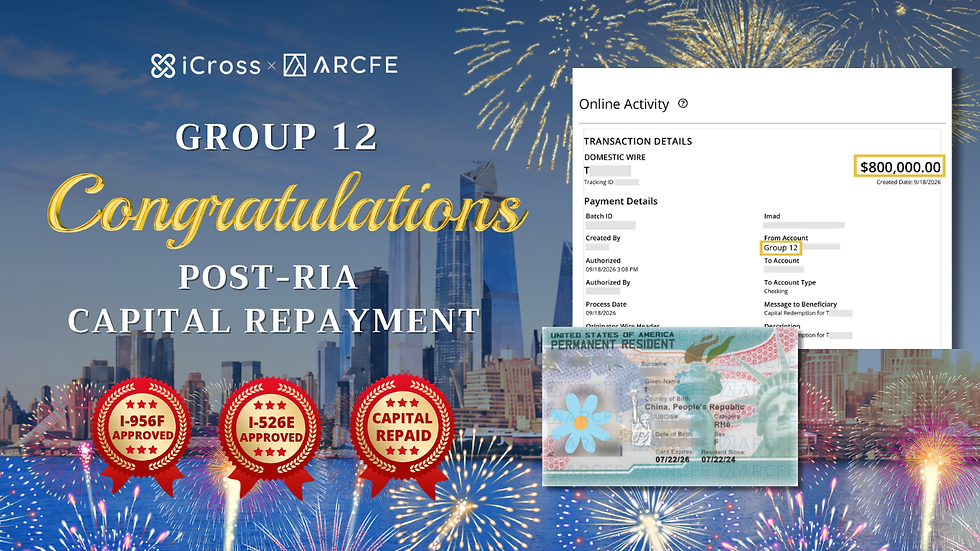
Recent ARCFE EB-5 Principal Repayment Highlights
Explore ARCFE’s latest EB-5 principal repayment milestones across pre-RIA and post-RIA projects. Click any image below to read the full project update.

Explore Current New York Real Estate-Backed EB-5 Opportunities


Considering EB-5 for Your Family?
Speak with an iCross × ARCFE EB-5 specialist to discuss your immigration goals, timeline, and available investment opportunities.
Related ARCFE Resources
Review important travel, residency, tax and immigration considerations after receiving a conditional green card.
Understand how senior debt, mezzanine financing and equity differ in repayment priority and risk exposure.
Disclaimer: Articles published under the "NYC Real Estate" category are curated from third-party media sources for informational purposes only. ARCFE does not claim ownership of the original content, nor does it guarantee the accuracy, completeness, or timeliness of the information presented. The views and opinions expressed in these articles are those of the original authors and do not necessarily reflect the position of ARCFE. Nothing contained herein constitutes investment, legal, or tax advice. Readers are encouraged to consult with qualified professionals before making any investment decisions.


