DHS Finalizes End of Automatic EAD Extensions: What I-485 Applicants Should Know


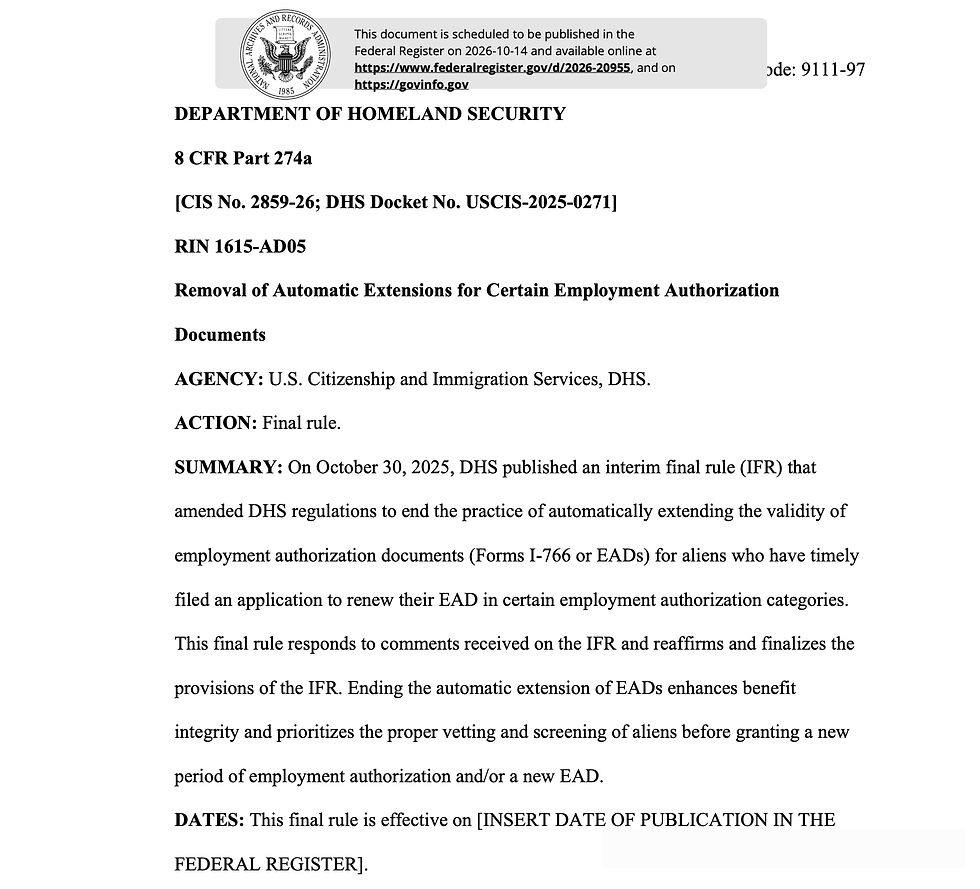
On October 13, 2026, the Department of Homeland Security (DHS) issued a final rule confirming the end of automatic Employment Authorization Document (EAD) extensions for certain renewal applicants. The policy has already been in effect since October 30, 2025; the new final rule makes that change permanent.
For adjustment-of-status applicants who work using a category C09 EAD, including some EB-5 investors filing Form I-485 while in the United States, the key issue is simple: a timely EAD renewal no longer automatically keeps work authorization in place under the affected categories.
What Changed, and When?
Before October 30, 2025, eligible EAD holders could receive an automatic extension of up to 540 days by submitting a qualifying Form I-765 renewal before the existing EAD expired.
DHS ended that mechanism for covered renewal applications filed on or after October 30, 2025, through an interim final rule. The October 2026 final rule confirms the policy following public comment. It does not retroactively cancel automatic extensions that were already available under the earlier rules.
Which EAD Categories Are Affected?
Several categories that previously qualified for automatic renewal extensions are affected. Common examples include:
Category | Typical applicant |
C09 | Pending Form I-485 adjustment-of-status applicant |
C26 | Eligible H-4 spouse |
C08 | Certain asylum applicants |
A03 / A05 | Refugees and individuals granted asylum |
A31 | Certain VAWA-related applicants |
A12 / C19 | Certain Temporary Protected Status (TPS) holders |
The precise rules vary by category. For EB-5 families pursuing concurrent filing, C09 is often the most relevant because an approved Form I-765 can provide employment authorization while the I-485 remains pending.
An EAD that expires before renewal approval can lead to a gap in work authorization unless the individual has a separate legal basis to work. Submitting the renewal on time, by itself, is not enough.
Does This End Every Automatic EAD Extension?
No. The rule concerns a particular renewal-based extension mechanism, not every form of employment authorization.
For example, eligible F-1 students who timely apply for a STEM OPT extension can still qualify for a separate 180-day automatic extension. Certain TPS extensions announced through separate Federal Register notices may also continue. Some L-2 and qualifying E spouses are authorized to work incident to their valid status.
What Should EB-5 Concurrent Filers Do?
Check your EAD expiration date early. Ask immigration counsel when you may file a renewal, and account for potential processing delays.
Confirm your work-authorization basis. If the existing C09 card expires before the renewal is approved, do not assume employment may continue. Counsel can assess whether another form of authorization applies.
Coordinate EAD, advance parole and I-485 planning. For investors using the EB-5 concurrent filing process, these applications can affect different aspects of a family's ability to work, travel and remain in the United States.
iCross × ARCFE continues to track immigration policy developments affecting investors and their families. For guidance on an individual EAD renewal or status issue, work with an experienced U.S. immigration attorney.
This article is for general information only and does not constitute legal, tax or investment advice.
Recent ARCFE EB-5 Principal Repayment Highlights
Explore ARCFE’s latest EB-5 principal repayment milestones across pre-RIA and post-RIA projects. Click any image below to read the full project update.


Explore Current New York Real Estate-Backed EB-5 Opportunities


Considering EB-5 for Your Family?
Speak with an iCross × ARCFE EB-5 specialist to discuss your immigration goals, timeline, and available investment opportunities.
Related ARCFE Resources
Review important travel, residency, tax and immigration considerations after receiving a conditional green card.
Understand how senior debt, mezzanine financing and equity differ in repayment priority and risk exposure.