
What Does “Sources and Uses of Funds” Mean in an EB-5 Project?

Updated: 1 day ago

Short answer: A sources-and-uses-of-funds statement shows where a real estate project expects to obtain its financing and how that capital will be spent. For EB-5 investors, it helps answer a fundamental question: Does the project have a credible funding plan to complete construction?
A balanced budget is a starting point, not proof that financing is secured. Investors should also examine funding commitments, construction costs and the role of EB-5 capital in the overall project.
Understanding Sources and Uses of Funds
Real estate developments typically combine several sources of financing. These may include developer equity, construction loans, EB-5 capital and other private investment.
The uses side of the statement accounts for the costs required to acquire, develop and complete the property.
Sources of Funds | Uses of Funds |
Developer and partner equity | Land acquisition and site preparation |
Bank or institutional construction loans | Construction and building systems |
EB-5 investment capital | Architecture, engineering and other development costs |
Other financing sources | Financing expenses, reserves and contingencies |
The two sides should reconcile to the project's total funding requirement. The examples in each column are independent categories, not one-to-one allocations.
For investors, the important question is whether the planned financing is sufficient, available when needed and supported by realistic cost assumptions.
Explore the Financing Behind a New York EB-5 Project
Considering a New York real estate-backed EB-5 investment? Review the development and request its current project and offering materials from ARCFE.
What Makes a Project's Funding Plan Credible?
Three factors deserve particular attention.
1. Committed Financing Versus Anticipated Financing
A project may identify a construction loan or expected EB-5 fundraising as part of its funding plan. Investors should distinguish capital already funded or contractually committed from financing that remains subject to conditions, lender approval or future subscriptions.
An identified funding source is not necessarily cash available for immediate use.
2. Construction Budgets and Contingencies
Construction costs can change because of labor expenses, material prices, design revisions or delays.
A credible budget should account for these risks and explain how additional costs would be funded. Investors should understand whether the financing plan includes contingency reserves and what happens if the original budget is exceeded.
3. The Position and Timing of EB-5 Capital
In a typical regional center structure, investors contribute capital to a New Commercial Enterprise (NCE), which may then provide financing to a Job-Creating Entity (JCE).
The terms of that financing determine how the capital is deployed, its position relative to other lenders or investors, and the contractual repayment arrangements.
These details are addressed in the project's governing and financing documents; a sources-and-uses table alone does not establish them.
For more on financing priority, see Understanding the EB-5 Capital Stack.
Sources and Uses of Funds vs. EB-5 Source of Funds
These terms sound similar but refer to different requirements.
Sources and uses of funds describes the financing and spending plan for the development.
EB-5 source of funds refers to the lawful origin of an individual investor's investment capital and the documentation supporting it.
Both matter, but they answer different questions. For the investor-level requirement, read ARCFE's EB-5 Source of Funds Guide.
USCIS requires regional center project applications to include a comprehensive business plan and a credible economic analysis. Investors should review the relevant project and offering documents to understand how financing, capital deployment and job creation are connected.
ARCFE Group 21: Evaluating the Financing Behind a New York Development
ARCFE Group 21 is associated with Skyline Tower II, a condominium development in Long Island City, Queens, involving United Construction & Development Group.
For this type of project, financing and repayment are distinct considerations.
Construction funding must support development expenditures as they arise. Future condominium sales may provide a source of loan repayment, but projected sales revenue is not the same as capital already available to fund construction.
Understanding that distinction is an important part of investment analysis.
ARCFE was founded by iCross Capital, a real estate financing institution with nearly two decades of experience in the New York City market. That lending background informs ARCFE's approach to evaluating project financing, developer experience and potential repayment sources.
What Should Investors Take Away?
Two developments can have similar construction budgets but very different financing risks.
Before investing, ask whether the funding plan is realistic, how much financing is committed, where EB-5 capital fits and what resources are available if project costs change.
A credible sources-and-uses statement explains how a project intends to fund its development. It does not, by itself, establish financial security or guarantee repayment.
To evaluate a New York real estate-backed EB-5 opportunity, explore ARCFE Group 21 and request the current offering and financing materials.
Disclaimer: This article is for educational purposes only and does not constitute immigration, legal, tax or investment advice. Financing arrangements vary by project and are governed by the applicable offering and investment documents. EB-5 investments involve risk, including the possible loss of principal. Investors should consult independent professional advisers before making an investment decision.
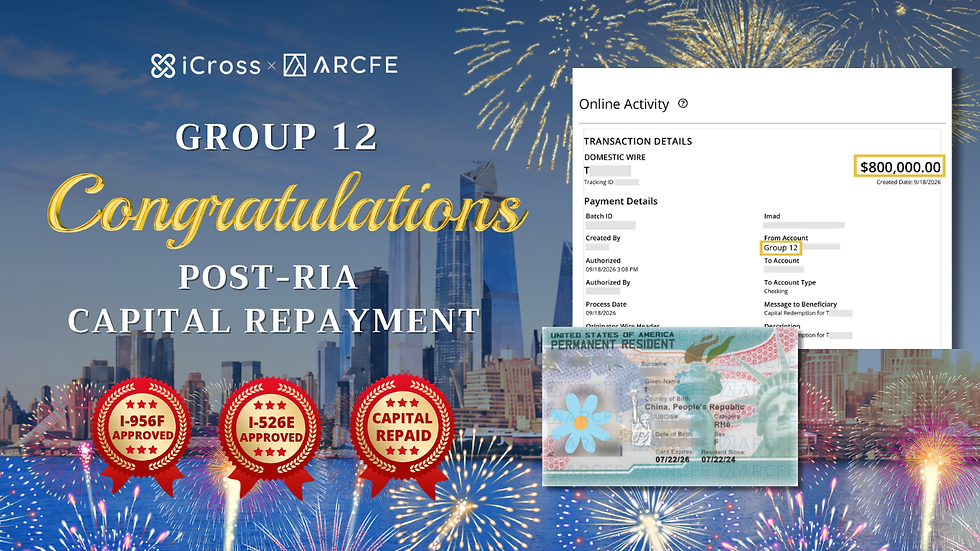
Recent ARCFE EB-5 Principal Repayment Highlights
Explore ARCFE’s latest EB-5 principal repayment milestones across pre-RIA and post-RIA projects. Click any image below to read the full project update.

Explore Current New York Real Estate-Backed EB-5 Opportunities


Considering EB-5 for Your Family?
Speak with an iCross × ARCFE EB-5 specialist to discuss your immigration goals, timeline, and available investment opportunities.
Related ARCFE Resources


