EB-5 I-829 Evidence: What Regional Center Investors Need to Show


For EB-5 investors, receiving a conditional green card is a major milestone. But the immigration process is not complete until the conditions on permanent residence have been removed.
That final stage involves Form I-829, Petition by Investor to Remove Conditions on Permanent Resident Status.
USCIS reviews whether the investor has satisfied the applicable investment and job creation requirements. For regional center investors, much of the supporting evidence comes from the underlying project and the records maintained throughout its development.
This makes I-829 preparation more than a filing exercise. The quality of the project documentation matters long before the petition is submitted.
What EB-5 I-829 Evidence Do Regional Center Investors Need?
According to the USCIS Form I-829 instructions, investors must provide evidence supporting their eligibility to remove the conditions on permanent residence.
For regional center investments, the evidence generally falls into several categories.
Area of Review | Examples of Supporting Evidence |
Qualifying investment | Subscription documents, bank records, and investment confirmations |
Capital deployment | NCE/JCE financing agreements, transfer records, and relevant disbursement documentation |
Capital account records, investment agreements, and transaction histories covering the applicable period | |
Job creation | Economic analysis, qualifying expenditure records, and other documents supporting the job creation methodology |
The precise evidence depends on the project's structure, the investor's filing history, and the applicable legal requirements.
For regional center projects, USCIS permits qualifying job creation to be supported through approved economic methodologies. The evidence therefore may look different from the payroll-based documentation used in a direct EB-5 case.
The USCIS Policy Manual on Removal of Conditions provides additional guidance on the relevant standards.
Considering EB-5 for Your Family?
Speak with an iCross × ARCFE EB-5 specialist to discuss your immigration goals, timeline, and available investment opportunities.
Job Creation Evidence: Connecting the Analysis to Actual Project Activity
An economic report may establish how many jobs a project is expected to create. At the I-829 stage, the supporting records must also substantiate the economic activity on which the job creation claim relies.
For a construction-based regional center project, this may involve qualifying expenditures supported by accounting records, payment documentation, construction reports, and updated economic analysis.
The objective is to establish a reliable connection between the project's documented activity and the qualifying jobs claimed under the applicable methodology.
Importantly, regional center investors do not necessarily need individual employment records for every indirectly created job. The evidence must support the methodology used to calculate those jobs.
The project's records should also be consistent with the relevant economic assumptions and properly account for material changes, where applicable.
Why Documentation Should Begin During Construction
By the time an investor becomes eligible to file Form I-829, the underlying development may have been underway for several years or may already be completed.
Reconstructing years of financial and construction activity shortly before filing can create unnecessary complications.
A more effective approach is to maintain appropriate records as the project progresses, including:
Capital transfers and qualifying use of investment funds;
Construction expenditures and major development milestones;
Material changes to budgets, financing, or project scope;
Updated information relevant to the economic analysis.
These records are not only useful for immigration documentation. They also support ongoing oversight of the project's financial and operational performance.
ARCFE discusses these responsibilities in EB-5 Regional Center Monitoring After Investment.
What If the Project Changes After the Initial Filing?
Real estate developments rarely proceed without adjustments.
Construction schedules may change, budgets may be revised, and financing arrangements may evolve. Such developments do not automatically mean an EB-5 investment will fail to satisfy its immigration requirements.
What matters is whether the changes affect relevant eligibility requirements, economic assumptions, or the documentation needed to support the investor's case.
Where necessary, the project team and economist may need to review the updated information, while immigration counsel evaluates any resulting legal or filing implications.
This is one reason why ongoing investor reporting matters. Clear communication helps investors and their attorneys understand material developments before those developments become last-minute filing questions.
The Regional Center and Immigration Counsel Have Different Roles
I-829 preparation requires coordination between the investor, immigration attorney, and relevant project parties.
The regional center and project team are generally important sources of project-related information, including capital deployment records, development updates, and documentation supporting job creation.
The investor's immigration attorney is responsible for evaluating the applicable legal requirements and preparing the individual petition.
Investors should understand this division of responsibility early.
A regional center's ability to maintain accessible, consistent project records is a practical consideration when evaluating its long-term investor support.
For the separate filing timeline and immigration procedures, see ARCFE's EB-5 I-829 Process Guide.
The iCross × ARCFE Perspective
At iCross × ARCFE, we believe effective EB-5 project management should support investors throughout the investment lifecycle, not only at the subscription stage.
Our approach draws on iCross Capital's New York real estate lending experience, with an emphasis on project monitoring, capital administration, construction progress, and documentation.
For regional center investors, these capabilities matter because the I-829 stage often depends on information accumulated over several years.
While immigration counsel determines how that information supports each individual filing, the regional center's project management and recordkeeping can play an important role in making relevant evidence available.
Strong I-829 preparation begins with disciplined project documentation—not with a last-minute request for records.
This article is provided for general information only and does not constitute legal, immigration, tax, or investment advice. I-829 requirements and supporting evidence vary according to the applicable law, project structure, and individual circumstances. Project documentation and prior approval history do not guarantee approval of an individual petition.
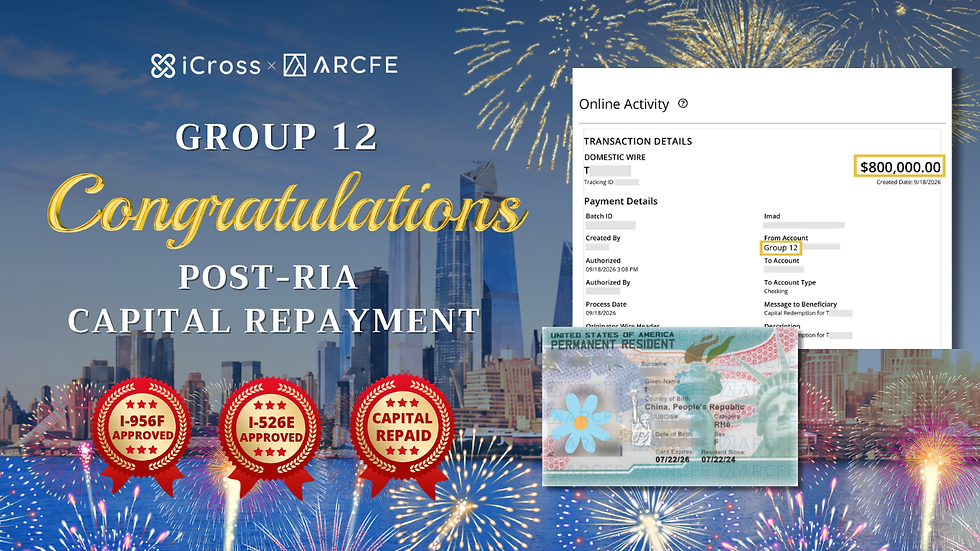
Recent ARCFE EB-5 Principal Repayment Highlights
Explore ARCFE’s latest EB-5 principal repayment milestones across pre-RIA and post-RIA projects. Click any image below to read the full project update.

Explore Current New York Real Estate-Backed EB-5 Opportunities


Considering EB-5 for Your Family?
Speak with an iCross × ARCFE EB-5 specialist to discuss your immigration goals, timeline, and available investment opportunities.
Related ARCFE Resources
Review important travel, residency, tax and immigration considerations after receiving a conditional green card.
Understand how senior debt, mezzanine financing and equity differ in repayment priority and risk exposure.
For more on this topic, read EB-5 Job Creation: Why the 10-Job Minimum Is Only the Starting Point.