
H-1B Policy Changes: $100,000 Measure Extended, Employer Layoffs Face Scrutiny

Updated: 21 hours ago

On September 18, 2026, the White House issued two H-1B policy changes: a proclamation stating that the $100,000 payment requirement for certain H-1B cases would be extended through September 21, 2027, and an executive order directing agencies to consider relevant layoffs by sponsoring employers.
The extension does not mean the $100,000 payment is being collected now. A federal court vacated the agencies’ implementation of the requirement, and the First Circuit declined to pause that ruling while the government’s appeal proceeds.
The $100,000 H-1B Measure Remains in Litigation
The measure was designed primarily for certain new H-1B petitions involving workers outside the United States who would enter to work. It is not a payment imposed on every H-1B holder or every application filed within the United States.
Although the White House has announced an extension, the agency policy implementing the payment remains vacated under the current court ruling. Employers and applicants should follow the litigation and current agency instructions before making filing or travel decisions.

Employer Layoffs Become a Review Factor
The new order directs federal agencies to consider whether an H-1B sponsor has directly or indirectly laid off workers in the past year—or plans layoffs—that negatively affect similarly situated U.S. workers.
This does not mean that every employer with a layoff record will be denied an H-1B petition. It does mean that relevant staffing decisions may receive closer attention when agencies review H-1B filings.

Speak with our EB-5 specialist and learn how the program can help you achieve permanent residency. Complete the form and our team member will give you a call back.
What the H-1B Policy Changes Mean for Applicants
For F-1 students and OPT participants already in the United States, the extension does not itself change their current status. Anyone preparing an H-1B filing should review the proposed role, filing route, employer circumstances and travel plans with immigration counsel.
For professionals whose long-term residence plans depend on employer sponsorship—including many India-born applicants navigating employment-based visa backlogs—it may also be worth evaluating alternatives early.
Where EB-5 May Fit
For families with qualifying capital, EB-5 offers a potential route to permanent residence without employer sponsorship. Eligible applicants in the United States may be able to file Form I-526E and Form I-485 together when an immigrant visa is available and they otherwise qualify. They may also apply for employment authorization and advance parole.
Filing alone does not grant permission to work or travel, preserve H-1B status, or guarantee approval. Visa availability—including the applicable category for India-born investors—must be checked before filing. ARCFE’s concurrent filing guide explains the key requirements.
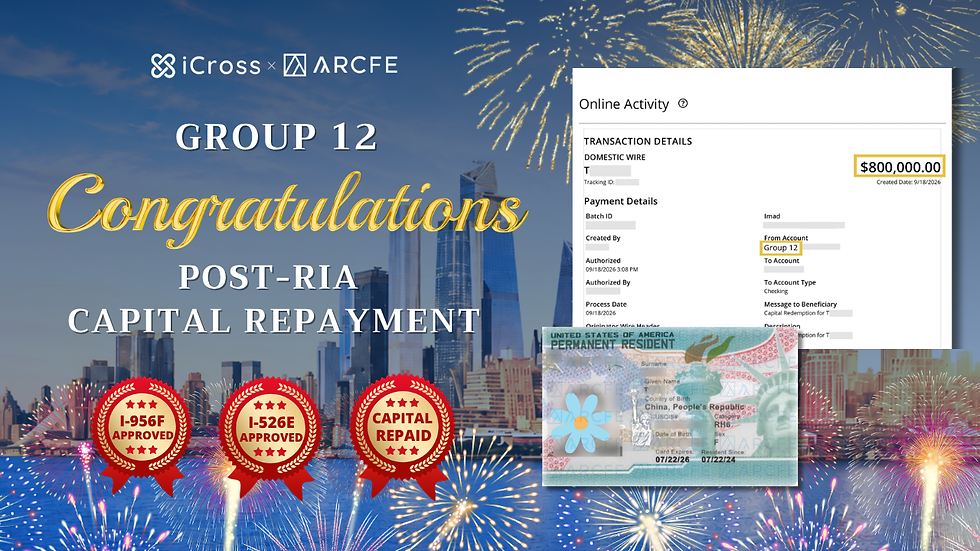
Recent ARCFE EB-5 Principal Repayment Highlights
Explore ARCFE’s latest EB-5 principal repayment milestones across pre-RIA and post-RIA projects. Click any image below to read the full project update.


Explore Current New York Real Estate-Backed EB-5 Opportunities


Considering EB-5 for Your Family?
Speak with an iCross × ARCFE EB-5 specialist to discuss your immigration goals, timeline, and available investment opportunities.
Related ARCFE Resources
Review important travel, residency, tax and immigration considerations after receiving a conditional green card.
Understand how senior debt, mezzanine financing and equity differ in repayment priority and risk exposure.


