What Is an EB-5 Job Creation Cushion, and Why Does It Matter?


Short answer: An EB-5 job creation cushion is the number of qualifying jobs a project is expected to create beyond the minimum required for its EB-5 investors.
Under the EB-5 program, each investor must support the creation of at least 10 qualifying full-time jobs. A larger job creation cushion provides an additional margin if actual qualifying job creation falls short of projections.
For investors, both the size of the cushion and the reliability of the underlying estimates matter.
How Is an EB-5 Job Creation Cushion Calculated?
Regional center projects may count qualifying direct and indirect job creation using accepted economic methodologies.
The calculation is straightforward:
Job Creation Cushion = Projected Qualifying Jobs − Minimum Jobs Required
Consider a hypothetical project with 50 EB-5 investors:
Job Creation Measure | Example |
EB-5 investors | 50 |
Minimum jobs required | 500 |
Projected qualifying jobs | 750 |
Job creation cushion | 250 jobs (50%) |

In this example, the project is expected to create 50% more jobs than the minimum requirement.
This additional margin is useful, but it does not guarantee immigration approval. The projected jobs must still be supported by an appropriate economic methodology and qualifying project activity.
For details, see the USCIS EB-5 Immigrant Investor Program.
For a real-world comparison, see ARCFE Group 21's published project information.
Why Does the Job Creation Cushion Matter?
Job creation estimates in real estate-backed EB-5 projects often depend on construction expenditures and other economic activity.
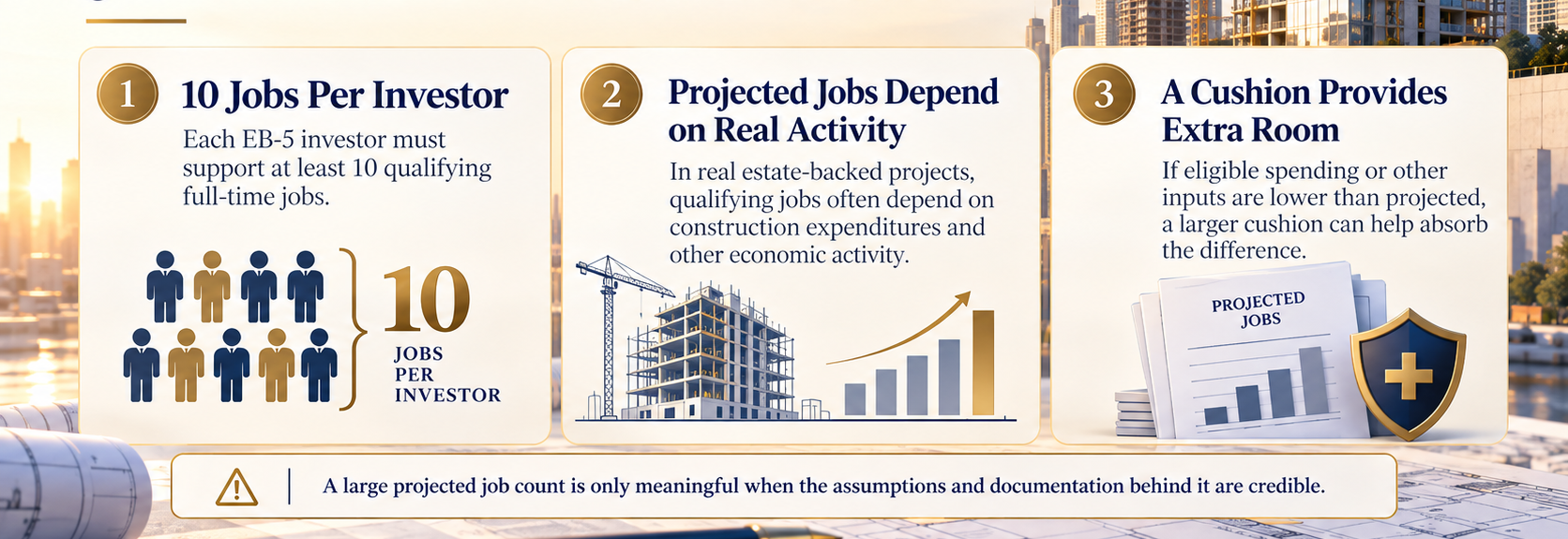
If eligible project spending is lower than anticipated, the number of qualifying jobs supported by the economic analysis may also change.
A cushion provides additional room for such differences. However, a large projected job count is only meaningful when the assumptions behind it are credible.
Investors should consider whether the construction budget is realistic, how the economic analysis calculates employment and whether the projected jobs are supported by reliable documentation.
Not every projected job necessarily qualifies: USCIS's project application guidance explains the applicable rules for counting direct and indirect jobs, including limits for some construction activity.
USCIS also requires supporting evidence of qualifying job creation during the removal-of-conditions process, as explained in the Form I-829 Instructions.
ARCFE Group 21: A New York EB-5 Example
ARCFE Group 21 is a real estate-backed EB-5 investment associated with Skyline Tower II in Long Island City, Queens.

According to the project's current published information, Group 21 provides for 70 EB-5 investors, corresponding to a minimum requirement of 700 qualifying jobs. The project currently lists 3,781 projected jobs.
Based on those projections, the job creation cushion is 3,081 jobs (approximately 440% above the minimum). This is a projected margin, not proof that all jobs have been created or will qualify for EB-5 purposes.
Investors can compare this requirement with the project's economic impact analysis to understand its projected job creation cushion and the assumptions supporting that estimate.
ARCFE was founded by iCross Capital, a New York City real estate financing institution with nearly two decades of experience in the local market.
That background informs ARCFE's approach to evaluating EB-5 opportunities, including the relationship between construction budgets, project execution, financing and job creation.
What Should Investors Take Away?
A job creation cushion is a useful measure, but investors should look beyond the headline number.
The key is to understand how many jobs are required, how many are projected and what evidence supports those projections.
At ARCFE, we believe a sound EB-5 investment decision starts with understanding both the immigration requirements and the underlying real estate project.
The financing structure is another part of due diligence. ARCFE's EB-5 capital stack guide explains how investment priority and repayment risk should be evaluated separately from job creation.
Recent ARCFE EB-5 Principal Repayment Highlights
Explore ARCFE’s latest EB-5 principal repayment milestones across pre-RIA and post-RIA projects. Click any image below to read the full project update.


Explore Current New York Real Estate-Backed EB-5 Opportunities


Considering EB-5 for Your Family?
Speak with an iCross × ARCFE EB-5 specialist to discuss your immigration goals, timeline, and available investment opportunities.
Related ARCFE Resources
Review important travel, residency, tax and immigration considerations after receiving a conditional green card.
Understand how senior debt, mezzanine financing and equity differ in repayment priority and risk exposure.